An effective eight-week Bocconi plan begins with a full diagnostic, gives most repair time to the topics causing the largest score losses, and gradually moves into mixed 75-minute simulations. This schedule covers the standard 50-question test, not the separate Law test. Adapt the workload to your baseline, available hours, selected programmes, and the date by which you need a usable score report.
Before week 1: verify the right test
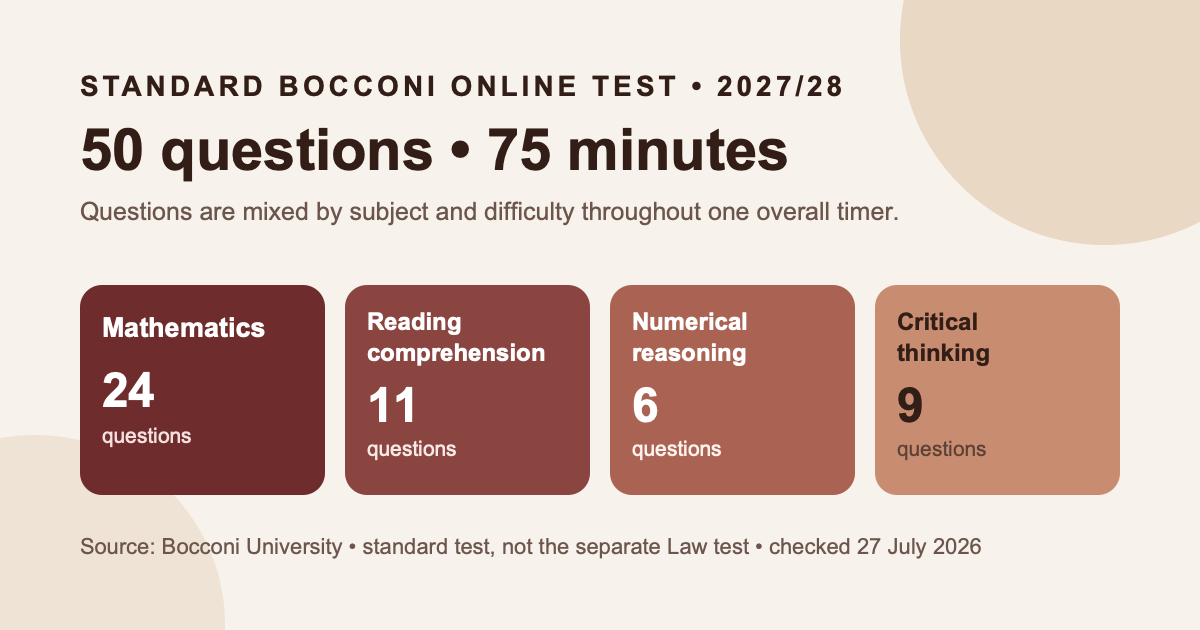
The official Bocconi test page separates the standard test from the Law test. This plan is for the standard version: 24 Mathematics, 11 Reading comprehension, 6 Numerical reasoning, and 9 Critical thinking questions.
Confirm:
- that the standard test is appropriate for every programme you may list;
- your Italian or international applicant category;
- the application session and last practical test date;
- whether Mathematical and Computing Sciences for Artificial Intelligence is a preference;
- whether you will test in Italian or English;
- a repeatable weekly study budget.
The schedule assumes roughly 8–12 focused hours each week. That range is UniExamFocus planning advice, not a Bocconi requirement.
Eight-week schedule
| Week | Main job | Evidence produced | |---|---|---| | 1 | Full diagnostic and classification | Overall score, four area scores, error log, timing trace | | 2 | Mathematics foundations | Two repaired high-loss maths topics | | 3 | Reading and numerical reasoning | Timed sets with documented decision errors | | 4 | Critical thinking and mixed transitions | Three mixed sets and updated skip rule | | 5 | Speed with accuracy | Two 75-minute attempts and pacing checkpoints | | 6 | Full simulations | Two reviewed simulations on separate days | | 7 | Repeated-error repair | Focused retests plus one full attempt | | 8 | Stable execution and logistics | Final score band, strategy, technical check |
Week 1: establish a truthful baseline
Take one 50-question test in 75 minutes with the official subject distribution and mixed order. Do not pause the timer to research unfamiliar content.
For every wrong or blank answer, record:
- subject area and topic;
- knowledge, interpretation, process, or time as the main cause;
- confidence before seeing the answer;
- time spent;
- whether the penalty was −0.2 or −0.33.
Calculate the score with the Bocconi scoring rules. The diagnostic is useful only if it exposes weaknesses; a low baseline is not a forecast of the final selection result.
Weeks 2–3: repair the largest losses
Mathematics represents 24 of 50 questions, so it deserves substantial time, but do not allocate effort from count alone. Combine frequency with your diagnostic.
Use a repair loop:
- Retrieve the rule or method without notes.
- Study the missing step.
- Solve a short untimed topic set.
- Explain why each distractor fails.
- Retest after a gap.
- Place the topic inside a mixed set.
In week 3, practise reading comprehension and numerical reasoning with a visible distinction between locating information and drawing an inference. For tables and charts, state the requested quantity and units before calculating.
Week 4: critical thinking and transitions
Bocconi describes Critical thinking items that require conclusions based only on presented information, including true, false, or not deducible decisions. Practise resisting plausible outside knowledge.
Mix all four areas because the real test does. Track the cost of switching from a passage to algebra or from a chart to an argument. Create a simple stopping rule: after a planned time or a failed approach, choose whether to eliminate, answer, or move on.
| Repeated problem | Training response | |---|---| | Reading beyond the supplied evidence | Mark the sentence that supports the answer | | Long algebra with no plan | Name the target and choose a transformation first | | Chart error | Restate axes, units, and comparison | | Critical thinking distractor | Classify it as contradicted, unsupported, or irrelevant | | Too much time on one item | Rehearse the stopping rule in short mixed sets |
Week 5: train the overall timer
The standard test has one 75-minute limit rather than subject timers. Take two full attempts and note cumulative time after questions 10, 20, 30, and 40. These are personal checkpoints, not an official pacing requirement.
Compare:
- overall and subject scores;
- correct, wrong, and blank counts;
- penalty points lost;
- items exceeding your stopping rule;
- accuracy in the final 15 minutes.
If speed improves while penalties rise, reduce rushed attempts. If accuracy is high but many answerable items remain blank, add short mixed sprints.
Week 6: simulate, then review
Complete two full simulations on different days. Keep the language, question mix, timer, and workspace consistent with your planned attempt.
Spend a separate review block on each simulation. Re-solving immediately is not enough: write the cause of each lost point and the change that would prevent it. Rank repairs by repeated score loss, not by which topic feels most comfortable to study.
Week 7: fix only recurring patterns
Select the errors present in at least two recent attempts. Use short blocks to repair them, then test transfer in a mixed set. Maintain stronger areas with small spaced sets.
If MCSAI is among your choices, monitor Mathematics separately against Bocconi’s stated 11/24 minimum while continuing to protect the overall 17-point eligibility floor. Neither number is sufficient for admission by itself.
Take one full simulation late in the week and compare it with a three-attempt score band, not only your best result.
Week 8: stabilise and prepare the environment
Take one or two final simulations early in the week. Then reduce volume, use brief recall, and complete the practical steps on the official page:
- check the current technical requirements;
- prepare the permitted room and devices;
- read the Instructions and Rules of Conduct;
- verify identification and login details;
- confirm your date, time, and support route.
The actual test is recorded and uses a lockdown browser. Bocconi’s free simulation does not reproduce proctoring, so technical preparation is a separate task.
If you have fewer or more hours
| Weekly time | Adaptation | |---|---| | 4–6 hours | Keep diagnostics and full reviews; halve routine set volume | | 8–12 hours | Follow the schedule as written | | 13–16 hours | Add spaced retests and reading review before more simulations | | More than 16 hours | Protect recovery and add volume only when errors are reviewed |
With fewer than eight weeks, preserve the sequence: diagnose, repair, mix, simulate, and taper. Combine weeks rather than skipping review.
Next step
Use the mathematics topic guide for the largest subject area and the dates checklist to ensure the test result exists before your application deadline. Recheck Bocconi’s current pages if any rule or date changes.
Adaptive plan
Allocate your weekly study time
Choose your time and priority. The allocation protects targeted repair, mixed practice, and simulation review.
Targeted repair: Mathematics
Mixed sets and recall
Timing, simulation, and review
Average per study day: 120 min
This is UniExamFocus planning advice, not an official prescription. Change the priority using evidence from practice.
Move from the rules to focused Bocconi Online Test practice.
Transparency
Review, sources, and updates
Open each section to see who worked on the guide, which sources were used, and what changed.
Editorial reviewEditorial Team + Fact-Checking Team
UniExamFocus is an independent preparation platform. It is not affiliated with CISIA, Bocconi, or any university mentioned, and it does not guarantee admission.
Official sources2
Update history1
- First publication, aligned to Bocconi’s official 2027/28 standard-test format and scoring.
Published Updated