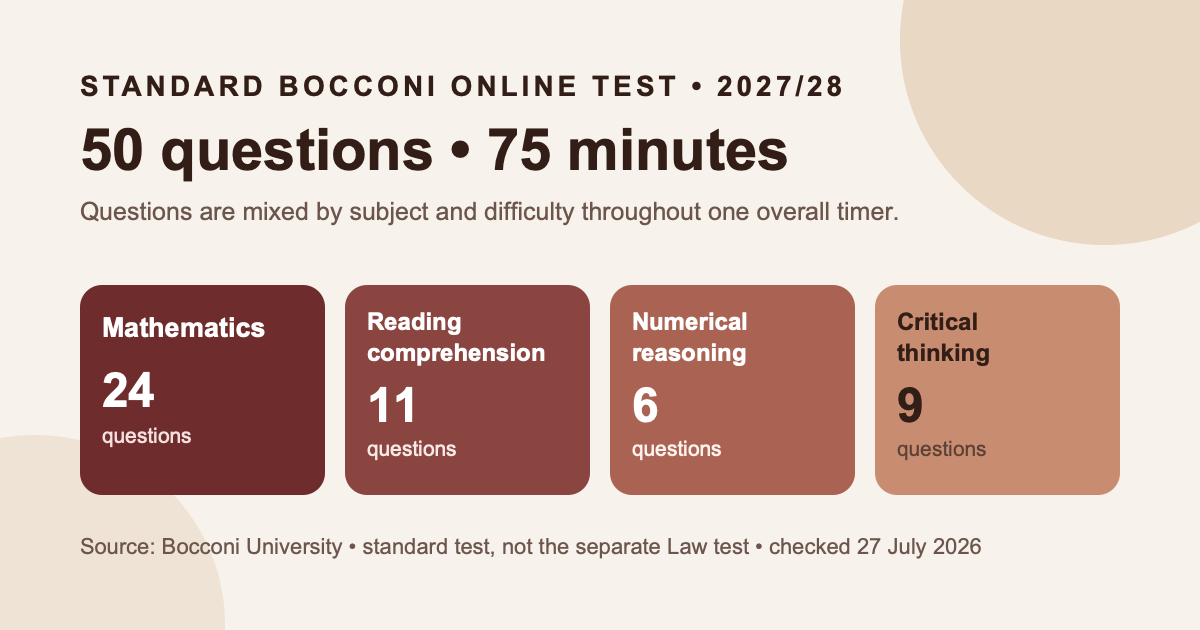
Mathematics contributes 24 of the 50 questions in the standard Bocconi Online Test for 2027/28. The official scope includes algebra, functions, geometry, trigonometry, sets, logarithms and exponentials, discrete mathematics, numbers, probability, problem solving, and statistics. There is no separate Mathematics timer: those questions appear within the mixed 75-minute test, so topic knowledge and transition speed both matter.
Official mathematics topic map
The official 2027/28 page lists:
| Topic group | Skills to practise | |---|---| | Algebra | Polynomials, powers, radicals, equations, inequalities, systems, absolute values, and rearranging relations | | Functions | Notation, formulas, inverse and composite functions, and elementary graphs | | Plane and analytical geometry | Standard shapes, distance, lines, slope, intersections, parabolas, and circles | | Trigonometry | Identities, sine, cosine, tangent, inverses, graphs, and right-triangle use | | Sets | Inclusion, union, intersection, complement, and Cartesian product | | Logarithms and exponentials | Forms, identities, graphs, equations, and inequalities | | Discrete mathematics | Permutations, arrangements, combinations, and counting rules | | Numbers | Real-number order, operations, percentages, units, and conversions | | Probability | Union and intersection, total probability, conditional probability, and Bayes’ theorem | | Problem solving | Simple applied quantitative problems | | Statistics | Frequencies, distributions, central tendency, and dispersion |
This is a coverage map, not a promised question allocation. Bocconi publishes 24 Mathematics questions but does not assign a fixed number to each topic group.
Start with a diagnostic matrix
Take a mixed Mathematics set and label every item. Record accuracy, time, and confidence.
| Result | Priority action | |---|---| | Wrong, low confidence | Relearn the concept and complete untimed examples | | Wrong, high confidence | Identify the misconception behind the chosen option | | Correct, slow | Find a shorter recognition or solution route | | Correct, fast | Maintain through spaced mixed practice | | Blank after a failed approach | Create an earlier stop-and-switch trigger |
Rank priorities using lost points, recurrence, and time. Do not spend equal hours on every heading simply because each appears in the syllabus.
Build fluency before speed
For a weak topic:
- Recall the definition or relationship without notes.
- Solve one representative example slowly.
- Compare at least two solution routes where possible.
- Complete a short single-topic set.
- Explain every wrong answer.
- Retest after a gap.
- Mix the topic with unrelated questions.
Speed built on an unstable method produces more −0.2 penalties. First make the process repeatable, then time it.
Timing inside a mixed 75-minute test
The overall average is 90 seconds per question, but using 90 seconds as a hard cap for every Mathematics item is artificial. Bocconi says time varies by question type.
Use personal checkpoints:
- identify the target quantity before calculating;
- stop if you cannot name a viable next step;
- estimate when it can eliminate options;
- check signs, domains, and units before committing;
- move on before one long problem consumes several answerable items.
During full simulations, record which Mathematics questions exceed your intended stopping rule. Retest those skills in mixed order, because the real paper alternates subjects and difficulty.
Protect points from common process errors
| Error | Control | |---|---| | Solving the wrong quantity | Write the required output first | | Ignoring a domain or sign condition | State constraints beside the equation | | Unit mismatch | Convert before substituting | | Diagram assumption | Use only marked or derived properties | | Probability denominator error | Define the sample space explicitly | | Correct method, arithmetic slip | Estimate the order and sign of the result |
These controls should be short enough to use under time pressure.
MCSAI applicants: monitor 11 out of 24
If you list the Bachelor in Mathematical and Computing Sciences for Artificial Intelligence, Bocconi states that you need at least 11 points out of 24 in Mathematics, in addition to the general overall threshold.
Because wrong answers are penalised, 11 correct answers do not automatically equal 11 points if other Mathematics answers are wrong. Track the subject score using the official penalty rules. This is an eligibility minimum for that programme, not an admission guarantee.
A weekly Mathematics routine
Use three different sessions:
- repair: one weak topic, untimed then lightly timed;
- mixed set: several official topics without labels;
- full integration: Mathematics interleaved with reading, numerical reasoning, and critical thinking.
End each week by ranking the next three repairs from evidence. The eight-week Bocconi plan shows where these sessions fit around simulations.
Scope note
This topic map is for the standard 2027/28 Bocconi Online Test. The separate Law test has only five Mathematics questions and a narrower published scope; UniExamFocus does not present this guide as Law-test preparation. Recheck Bocconi’s official page for any update.
Quick diagnostic
Turn the syllabus into priorities
Rate each section after a mixed diagnostic. Weak and untested areas move to the top of the list.
Rate at least one section to build your list.
This list organizes your diagnostic; it does not predict question distribution in the test.
Move from the rules to focused Bocconi Online Test practice.
Transparency
Review, sources, and updates
Open each section to see who worked on the guide, which sources were used, and what changed.
Editorial reviewEditorial Team + Fact-Checking Team
UniExamFocus is an independent preparation platform. It is not affiliated with CISIA, Bocconi, or any university mentioned, and it does not guarantee admission.
Official sources2
Update history1
- First publication, with the mathematics scope checked against Bocconi’s 2027/28 test page.
Published Updated