The standard Bocconi test awards +1 for a correct answer, 0 for a blank, and −0.2 for a wrong answer. Certain Critical thinking questions with three options use a −0.33 penalty instead. A total below 17 is not considered for selection, but 17 is only an eligibility floor: it does not mean that an applicant will be admitted.
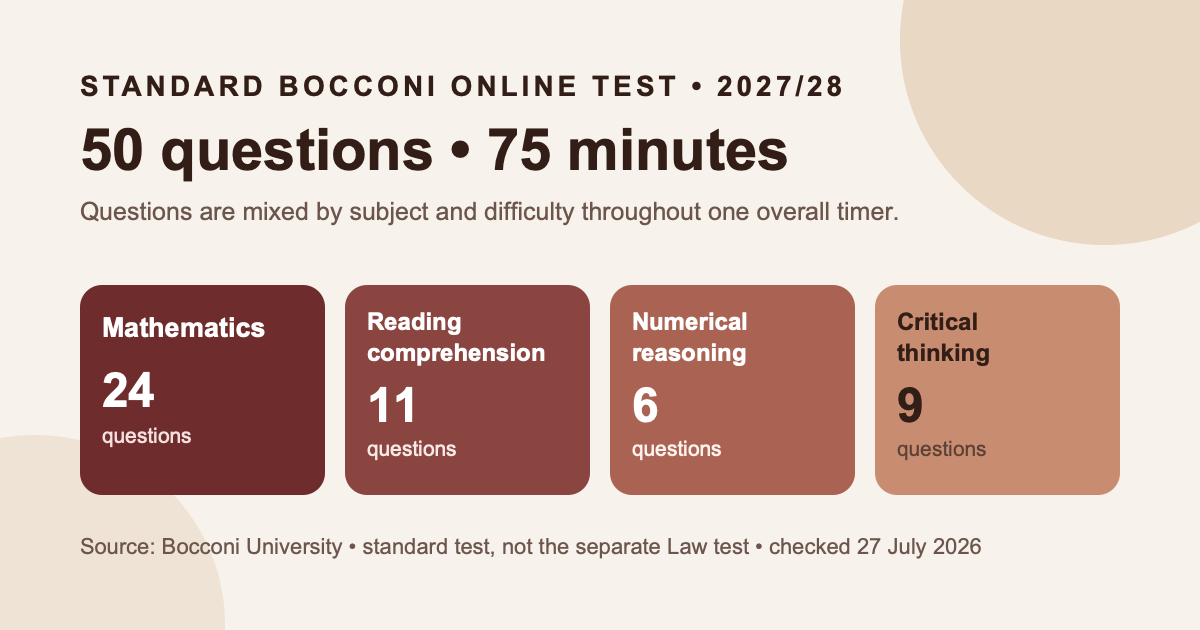
Official Bocconi scoring rules
The official test page publishes these values:
| Response | Score | |---|---:| | Correct | +1 | | Unanswered | 0 | | Wrong, regular question | −0.2 | | Wrong, three-option Critical thinking question | −0.33 |
To calculate a practice score accurately, your simulator must identify which wrong Critical thinking items had three answer options. Applying −0.2 to every error can overstate the result.
Worked score example
Suppose a 50-question attempt contains:
- 34 correct answers;
- 10 unanswered;
- 4 wrong regular questions;
- 2 wrong three-option Critical thinking questions.
The calculation is:
34 − (4 × 0.2) − (2 × 0.33) = 32.54
This produces 32.54 points. If both Critical thinking errors had more than three options, the calculation would instead be 34 − (6 × 0.2) = 32.8. Record the question type rather than reconstructing it from memory after the test.
What does the 17-point minimum mean?
Bocconi states that applicants with a total below 17, after penalties, are not considered in the selection. A score of 17 or more makes the result usable for an application; it does not secure admission.
The current admissions page says the selection test contributes 55% of the assessment and the relevant high-school GPA contributes 45%. Ranking position, programme preferences, applicant category, available places, and the strength of the pool still matter.
Treat these as different questions:
| Question | Official answer | |---|---| | Can a result below 17 enter the selection? | No | | Is 17 sufficient for admission? | No | | Is the test the only ranking element? | No; it is 55% for the stated 2027/28 process | | Is there one safe score for every programme? | Bocconi does not publish such a universal guarantee |
The additional mathematics threshold
Applicants who list the Bachelor in Mathematical and Computing Sciences for Artificial Intelligence must also obtain at least 11 points out of 24 in Mathematics on the standard Bocconi test to be considered for that programme.
That is a programme-specific extra condition, not a new general minimum. A candidate could clear 17 overall but remain ineligible for that choice if the Mathematics score is below 11. The mathematics guide shows how to monitor this separately.
Should you guess or leave a blank?
The score impact depends on how many options remain and whether the item is a three-option Critical thinking question. A blind guess across equally plausible options can differ from an informed guess after elimination.
Use a controlled practice rule:
- answer when you can justify the choice;
- eliminate options explicitly before guessing;
- compare the likely gain with the time needed;
- leave an item when continuing would consume time needed for higher-confidence questions;
- review whether your wrong answers came from knowledge, reasoning, or rushed guessing.
This is UniExamFocus preparation advice, not an official Bocconi test-taking instruction. Bocconi lets each applicant choose which questions to answer.
Turn the score report into a decision
Bocconi says the report, available within approximately 48 hours, includes total and subject-area scores plus correct, wrong, and blank counts. Use those fields to diagnose the attempt:
| Pattern | Next action | |---|---| | Below 17 overall | Repair the largest score losses before selecting an attempt | | Above 17, weak Mathematics | Check the MCSAI threshold and rebuild the repeated topics | | Many blanks, high accuracy | Train mixed-question pacing under 75 minutes | | Many penalised errors, low confidence | Add an answer-or-skip rule and review elimination | | One weak area across attempts | Use topic blocks, then retest it inside a full mixed simulation | | Stable total but no target context | Recheck the programme and applicant-category admissions rules |
Do not compare a raw number from a differently structured test, an old academic year, or the separate Law test as though it were equivalent.
Choose which attempt to use
Bocconi’s admissions page says that if you provide multiple accepted test results, the application portal selects the highest submitted result. Its online-test page separately tells candidates to select the test attempt they intend to use. Follow the live application instructions if those descriptions appear different in your case, and never assume a webtesting result is imported automatically.
Use the structure and attempts guide to confirm the four-attempt limit, and place your next practice cycle into the eight-week plan.
Scope and update note
These rules apply to the standard 2027/28 undergraduate Bocconi Online Test. They do not turn the 17-point eligibility floor into a predicted admission cutoff. Check the official page again before purchasing, testing, or submitting an application.
Practical tool
Calculate a practice result
Enter the outcomes from the 50 main questions. This calculation does not interpret university thresholds or rankings.
The 17-point floor makes the result eligible for consideration; it does not guarantee admission.
Formula described and checked in this guide’s sources. Open the official source
Move from the rules to focused Bocconi Online Test practice.
Transparency
Review, sources, and updates
Open each section to see who worked on the guide, which sources were used, and what changed.
Editorial reviewEditorial Team + Fact-Checking Team
UniExamFocus is an independent preparation platform. It is not affiliated with CISIA, Bocconi, or any university mentioned, and it does not guarantee admission.
Official sources2
Update history1
- First publication, with penalties and thresholds checked against Bocconi’s official 2027/28 pages.
Published Updated