The CEnT-S syllabus has five separately timed sections: Mathematics, Reasoning on texts and data, Biology, Chemistry, and Physics. Mathematics and reasoning contain 15 questions each; biology and chemistry contain 10 each; physics contains 5. Cover every official topic, but choose your revision order from diagnostic evidence and any section requirements in your university’s admission notice.
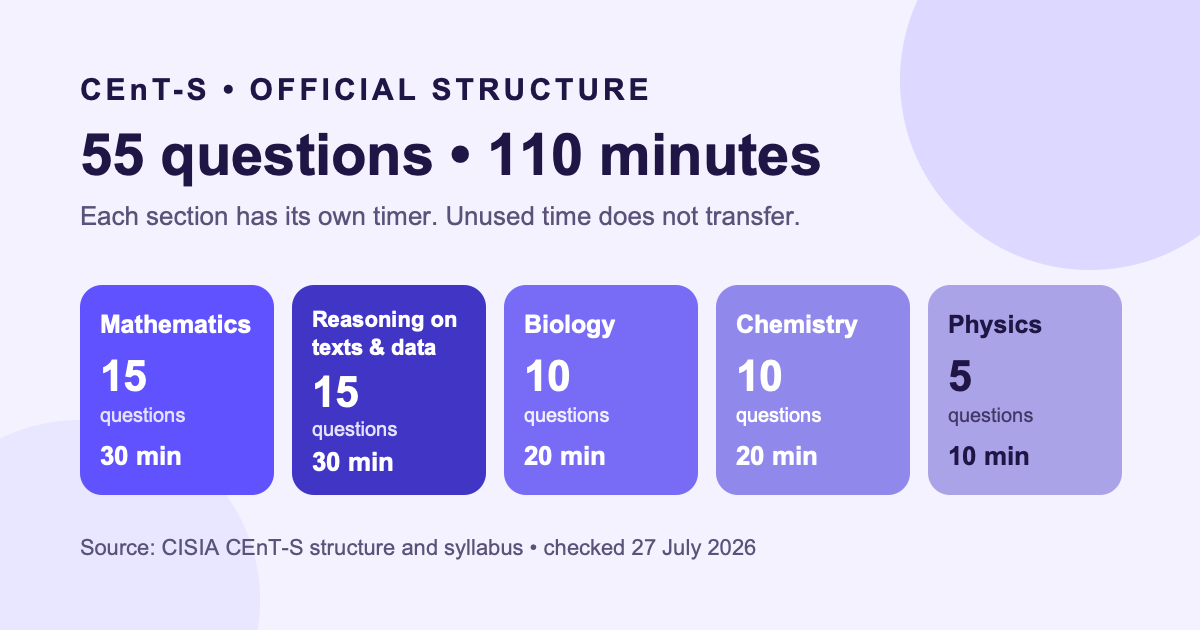
CEnT-S sections at a glance
The official CISIA syllabus gives every section its own time limit. You may finish a section early and move forward, but unused time does not transfer and you cannot return to a completed section.
| Section | Questions | Minutes | Average time per question | |---|---:|---:|---:| | Mathematics | 15 | 30 | 2 minutes | | Reasoning on texts and data | 15 | 30 | 2 minutes | | Biology | 10 | 20 | 2 minutes | | Chemistry | 10 | 20 | 2 minutes | | Physics | 5 | 10 | 2 minutes | | Total | 55 | 110 | 2 minutes |
Two minutes is only an average. Some items will take less and some more, so practise deciding when to continue rather than forcing every question into an identical time box.
Mathematics topics
CISIA groups mathematics into these nuclei:
- Numbers: operations and ordering, divisibility, factorisation, powers and roots, percentages, and expressions.
- Algebra: literal expressions, polynomial factorisation and roots, equations, inequalities, and simple systems.
- Geometry: the principal properties and measurements of plane and solid figures, coordinates, and geometric relationships.
- Functions: representations, domains and ranges, composition, inverses, and common algebraic functions.
- Exponentials and logarithms: their definitions, properties, graphs, equations, and inequalities.
- Combinatorics and probability: finite-set counting, dispositions, combinations, permutations, and basic event probabilities.
- Basic statistics: tables and graphs, frequencies, mean, median, and mode.
Do not interpret a long topic label as a promise of equal question frequency. The official page defines coverage, not a fixed blueprint for how many questions each nucleus will receive.
Reasoning on texts and data topics
This section tests three linked abilities:
- Logic and deductive reasoning: propositions, logical connectives, sets, counterexamples, and necessary or sufficient conditions.
- Interpretation and manipulation of data: extracting information from prose, tables, and graphs; moving between representations; and checking whether conclusions follow.
- Problem solving and basic mathematical language: organising information, estimating, using ratios and percentages, and translating words into equations or formulas.
Revision should mix content and representation. For example, solving only abstract logic items will not reveal whether a chart, a long prompt, or an unfamiliar diagram causes the real slowdown.
Biology topics
The official biology syllabus covers:
- biological properties of water and the major biomolecule classes;
- prokaryotic, animal, and plant cell structures and functions;
- DNA and RNA, replication, transcription, translation, the cell cycle, mitosis, meiosis, and Mendelian inheritance;
- plant structures, photosynthesis, ecosystems, food chains, and biotic interactions;
- mammalian tissues, organs, and the principal body systems.
Build links between structure and function rather than memorising disconnected labels. A useful self-test asks you to explain what changes when a component, process, or environmental relationship is altered.
Chemistry topics
CISIA’s chemistry nuclei span:
- macroscopic states, transformations, mixtures, and fundamental laws;
- atomic structure, formulas, bonds, molecular geometry, and intermolecular forces;
- the periodic table, electron configurations, and periodic trends;
- equations, moles, stoichiometry, limiting reactants, yield, and concentration;
- gases, thermodynamics, kinetics, equilibrium, and catalysis;
- nomenclature, solutions, solubility, and properties of compounds;
- acids, bases, pH, neutralisation, hydrolysis, and buffers;
- redox processes and balancing;
- core organic structures, functional groups, nomenclature, and reactions;
- measurement, everyday transformations, environmental chemistry, labels, and safety.
Quantitative chemistry deserves mixed practice: recognising the governing concept is only the first step, and unit handling often determines whether the final answer is usable.
Physics topics
The physics syllabus begins with quantities, SI units, scientific notation, estimates, graphs, common functional relationships, and vectors. It then covers:
- linear and circular kinematics;
- forces, equilibrium, and dynamics;
- work, energy, and power;
- fluids and thermodynamics;
- electricity and magnetism;
- waves, sound, and optics.
Physics has only five questions but still has a broad syllabus. Treat that as a reason to diagnose carefully, not as evidence that any listed area can be ignored.
Turn the syllabus into a priority list
First, take a mixed diagnostic without revising immediately beforehand. Label every question with its official nucleus, then record outcome, confidence, and time.
| Diagnostic result | Priority | |---|---| | Wrong and low confidence | Learn the concept, then complete untimed examples | | Wrong and high confidence | Correct the misconception and write why the chosen option failed | | Correct but slow | Practise recognition and a shorter solution route | | Correct and fast | Maintain with spaced mixed questions | | Blank because time expired | Rehearse section pacing and stopping decisions |
Rank topics using three factors: error frequency, time cost, and any university-specific section rule. This prevents “study the whole syllabus” from becoming an unstructured checklist.
What to do next
Use the CEnT-S scoring guide to convert each practice attempt into comparable raw section scores. Then schedule your priorities with the eight-week CEnT-S plan.
The official syllabus can change. Recheck CISIA and the official admission notice for your exact course before relying on a topic list or test format. UniExamFocus’s prioritisation method is independent preparation advice, not a CISIA rule.
Quick diagnostic
Turn the syllabus into priorities
Rate each section after a mixed diagnostic. Weak and untested areas move to the top of the list.
Rate at least one section to build your list.
This list organizes your diagnostic; it does not predict question distribution in the test.
Move from the rules to focused CEnT-S practice.
Transparency
Review, sources, and updates
Open each section to see who worked on the guide, which sources were used, and what changed.
Editorial reviewEditorial Team + Fact-Checking Team
UniExamFocus is an independent preparation platform. It is not affiliated with CISIA, Bocconi, or any university mentioned, and it does not guarantee admission.
Official sources2
- CISIA — CEnT-S structure and syllabusLast checked
- CISIA — CEnT rulesLast checked
Update history1
- First publication, with all section and topic groups checked against CISIA’s current syllabus.
Published Updated