This eight-week CEnT-S plan starts with a diagnostic, assigns more work to your weakest high-impact sections, and ends with full simulations under the official five-section timing. Use it as a framework rather than a fixed prescription: your university’s rules, your baseline, and your available hours should determine the exact allocation. Every week produces evidence that changes the next one.
Before week 1: confirm the test you need
The official CISIA CEnT-S page says the test is used by some universities for courses mainly taught in English across scientific and related fields. It also tells applicants to check the university’s admission notice before booking.
Record these details before building your schedule:
- the exact programme and intake;
- whether that programme accepts CEnT-S;
- the valid test period and application deadline;
- any overall or section threshold, weighting, or score transformation;
- the date by which your normalised result will be available;
- the preparation hours you can repeat each week.
This plan assumes roughly 8–12 focused hours per week. That is a planning range from UniExamFocus, not an official requirement. If you have fewer hours, keep the same sequence and reduce question volume rather than removing diagnostics or review.
The eight-week schedule
| Week | Main job | Deliverable | |---|---|---| | 1 | Baseline and error classification | One timed baseline, five section scores, and a ranked topic list | | 2 | Highest-priority foundations | Notes and untimed sets for the two weakest topic groups | | 3 | Second-priority foundations | Notes and untimed sets for the next two weak topic groups | | 4 | Mixed application | Three mixed sets plus an updated error log | | 5 | Section timing | Two timed attempts for each weak section | | 6 | Full-test integration | Two 110-minute simulations with complete reviews | | 7 | Targeted repair | Short blocks on errors that still repeat | | 8 | Stable execution | One or two final simulations, light recall, and logistics check |
Week 1: diagnose before you revise
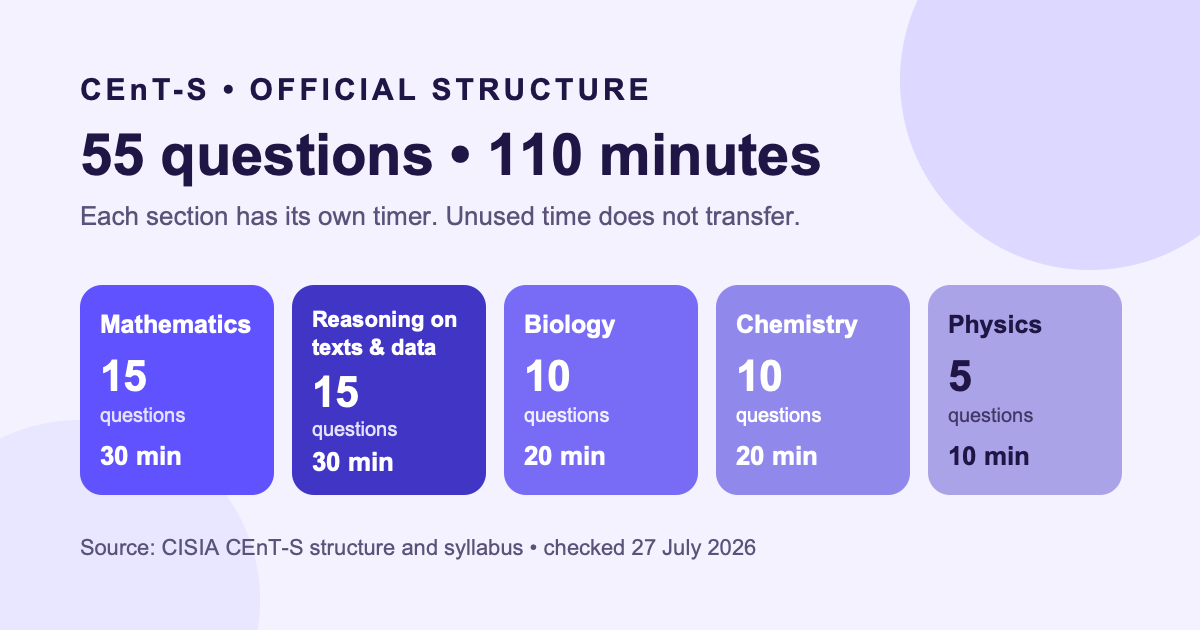
Take one full 55-question attempt using the official order and timers:
- Mathematics — 15 questions in 30 minutes
- Reasoning on texts and data — 15 in 30 minutes
- Biology — 10 in 20 minutes
- Chemistry — 10 in 20 minutes
- Physics — 5 in 10 minutes
Do not transfer unused time or return to an earlier section; the CEnT rules do not allow either on the real test.
For every error or blank, record the official syllabus topic, whether the issue was knowledge, method, reading, or time, and how confident you were. Calculate each section’s raw score with +1 correct, 0 blank, and −0.25 wrong. Do not attempt to invent a normalised score; CISIA determines those coefficients only after the macro-period.
Weeks 2–3: repair foundations
Allocate about 60% of study time to the two weakest important areas, 25% to the next priorities, and 15% to maintaining strengths. Adjust this if your university applies a section minimum or weighting.
Use a short learning loop:
- retrieve the rule, relationship, or concept from memory;
- study the missing step;
- solve a few untimed single-topic questions;
- explain each wrong option, not only the correct one;
- retest the same skill after a gap.
The CEnT-S syllabus guide maps the official topic nuclei so your error log uses consistent labels. End week 3 with short mixed sets; isolated practice alone cannot show whether you can identify the right method from an unfamiliar prompt.
Week 4: mix topics and representations
Move from predictable topic blocks to mixed work. Combine graphs with prose, algebra with data interpretation, and science recall with short calculations. The goal is selection: recognise which knowledge applies before executing it.
After each set, separate errors into:
| Error type | Repair | |---|---| | Knowledge gap | Relearn, then retrieve without notes | | Correct concept, wrong process | Write a shorter repeatable solution sequence | | Misread condition or unit | Underline constraints and state the required output | | Distractor chosen with confidence | Explain the misconception that made it attractive | | Ran out of time | Set an earlier stop-and-decide trigger |
Retake only after reviewing the cause. Repeating questions immediately can measure memory of the answer rather than improvement in the skill.
Week 5: train each fixed section
Now use the exact section timers. Complete at least two attempts for every section that still limits your result. Track:
- raw score;
- correct, wrong, and blank counts;
- time at the last attempted question;
- topics responsible for most lost points;
- decisions that consumed more time than they returned.
Compare raw section scores over multiple attempts, not just percentages. The CEnT-S scoring guide explains the penalty and why a practice provider cannot reproduce the official normalisation coefficient.
Week 6: join the five sections
Complete two full 110-minute simulations on separate days. Use a quiet setting, one continuous sitting, the official section order, and no return to previous sections.
Reviewing a simulation should take at least as much care as sitting it. For every lost point, decide whether the next action is content revision, a method change, or a timing rule. A score with no review produces little evidence for week 7.
Use this checkpoint:
- Improving and stable: retain the schedule and repair the few repeated errors.
- Improving but volatile: reduce new content and add shorter timed mixed sets.
- Flat with recurring gaps: return to the relevant foundation before another full test.
- Flat with time losses: practise stop decisions inside the affected section.
Week 7: repair only what still repeats
Rank the remaining errors by frequency and consequence. Spend most time on patterns that have appeared in at least two recent attempts. Maintain strong sections with brief mixed sets, but resist reopening every syllabus topic.
Take one full simulation near the end of the week. Use the result to set a simple test-day strategy: which item types you answer first, when you move on, and how you make the final answer-or-blank decision.
Week 8: make performance repeatable
Complete one or two simulations early in the week, not every day. Review them, then taper into short recall and confidence-building sets. Confirm identification, booking details, permitted materials, start instructions, travel or room setup, and the university deadline from official sources.
Do not make a late score spike the only definition of readiness. Look for a stable band across recent attempts, fewer repeated errors, and consistent section completion.
Adapt the plan to your available time
| Weekly time | Adaptation | |---|---| | 4–6 hours | Keep one diagnostic or simulation milestone, halve routine question volume | | 8–12 hours | Use the schedule as written | | 13–16 hours | Add review and spaced retesting before adding more simulations | | More than 16 hours | Protect recovery; extra volume is useful only when errors are reviewed well |
If you have fewer than eight weeks, preserve the sequence: diagnose, repair, mix, time, simulate, and taper. Combine neighbouring weeks instead of skipping error review.
Final check
CISIA can change the syllabus or rules, and each university controls its admission process. Recheck both official sources before the test. UniExamFocus is independent and this plan cannot determine whether a particular score will secure a place.
Adaptive plan
Allocate your weekly study time
Choose your time and priority. The allocation protects targeted repair, mixed practice, and simulation review.
Targeted repair: Mathematics
Mixed sets and recall
Timing, simulation, and review
Average per study day: 120 min
This is UniExamFocus planning advice, not an official prescription. Change the priority using evidence from practice.
Move from the rules to focused CEnT-S practice.
Transparency
Review, sources, and updates
Open each section to see who worked on the guide, which sources were used, and what changed.
Editorial reviewEditorial Team + Fact-Checking Team
UniExamFocus is an independent preparation platform. It is not affiliated with CISIA, Bocconi, or any university mentioned, and it does not guarantee admission.
Official sources2
- CISIA — CEnT-S structure and syllabusLast checked
- CISIA — CEnT rulesLast checked
Update history1
- First publication, aligned to the current official CEnT-S sections, timing, syllabus, and scoring rules.
Published Updated