CEnT-S gives +1 point for a correct answer, 0 for an unanswered question, and −0.25 for a wrong answer. That produces a raw score. CISIA then adds section-level normalisation coefficients after the macro-period to produce the official result. Your target is not universal: the university’s admission notice may transform, weight, or set thresholds for that result.
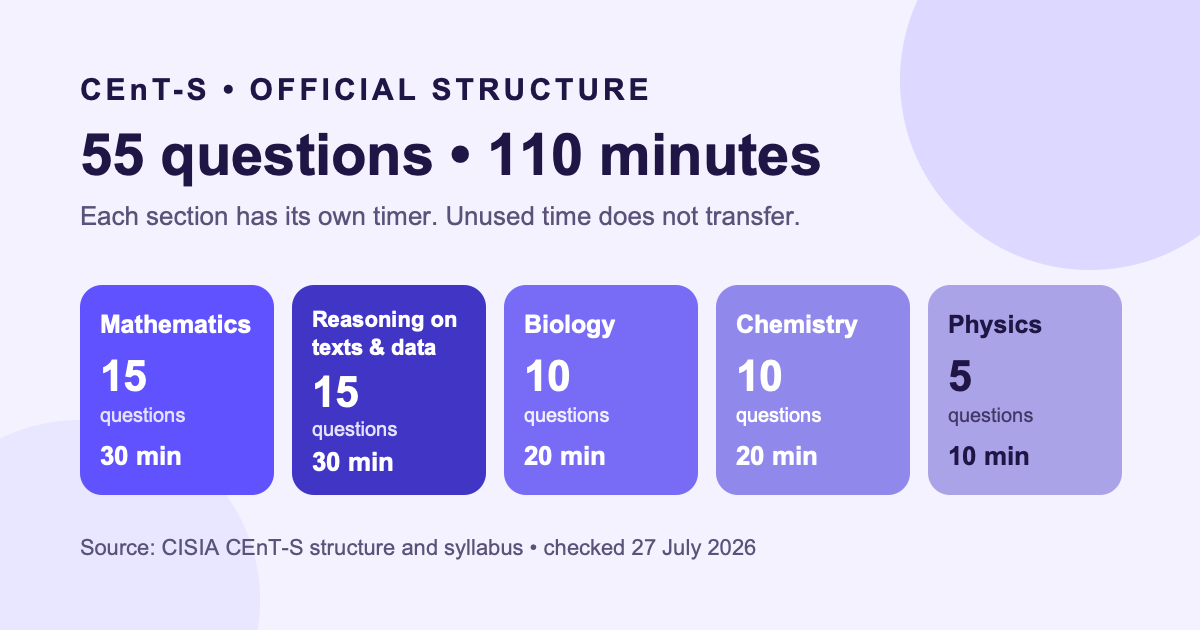
The CEnT-S scoring formula
The official CISIA structure page defines the raw score as:
raw score = correct answers − (wrong answers × 0.25)
Unanswered questions add zero. Calculate each section separately first, because normalisation is also applied at section level.
| Response | Raw-score effect | |---|---:| | Correct | +1 | | Unanswered | 0 | | Incorrect | −0.25 |
Worked raw-score example
Suppose your 55 answers include 36 correct, 11 wrong, and 8 unanswered:
- Correct-answer points:
36 × 1 = 36 - Wrong-answer penalty:
11 × 0.25 = 2.75 - Raw score:
36 − 2.75 = 33.25
That 33.25 is not a forecast of your final official result. The normalisation coefficients are not known when you sit the test, so a preparation platform cannot calculate the final score from correct, wrong, and blank totals alone.
How CISIA normalisation works
Under the current CEnT rules, CISIA assesses the actual ease of the questions after a macro-period ends. A section’s coefficient is the number of questions in that section minus the sum of its individual question-ease coefficients. CISIA then adds that coefficient to your raw section score.
In compact form:
normalised section score = raw section score + section normalisation coefficient
The overall normalised result is the sum of the five normalised section scores. A harder test version receives more compensation than an easier version. Because this comparison needs results from the whole macro-period, CISIA releases normalised scores only at the macro-period deadline.
| Macro-period | CISIA’s stated result deadline | |---|---| | First | 30 January | | Second | 31 March | | Third | 30 June | | Fourth | 30 October |
These are CISIA’s current general deadlines. Your university’s application deadline can be different, so make sure the result will exist in time for your programme.
Is it better to guess or leave a question blank?
If all five options are equally plausible, a completely random answer has an expected raw value of zero:
(1/5 × 1) + (4/5 × −0.25) = 0
Eliminating even one option makes the expected raw value positive, but that mathematical average does not account for your time or the opportunity to answer another question. Use this practical rule:
- answer immediately when you can justify the choice;
- mark your best choice when you can eliminate at least one option without losing valuable time;
- avoid spending the end of a fixed section on an answer you cannot narrow down;
- practise the decision under the same section timer, because you cannot return after moving on.
This is preparation advice based on the scoring formula, not an official CISIA instruction.
What counts as a good CEnT-S score?
There is no single responsible number for every applicant. CISIA provides the test and its result, while participating universities decide how they use it. The CEnT rules expressly allow universities to transform the score, apply section weights, or require minimum thresholds.
Use this decision sequence:
- Open the official admission notice for the exact degree programme and intake.
- Confirm that it accepts CEnT-S and identify the eligible test window.
- Record any overall threshold, section threshold, weighting, or ranking formula.
- Check whether the university uses your latest, best, or another specified attempt.
- Set a preparation target above the applicable historical boundary only if official past ranking data exists; never present that history as a future guarantee.
If the notice is unclear, ask the university admissions office in writing. Do not substitute a third-party “good score” claim for the programme’s own rule.
Turn a practice result into a study decision
Calculate raw scores by section, then prioritise the weakness that is both improvable and important under your university’s method.
| Practice pattern | Next action | |---|---| | Low accuracy, plenty of time left | Rebuild the underlying topic before adding speed | | High accuracy, many unanswered | Add short timed sets and a stopping rule | | Repeated −0.25 losses between two options | Log why the eliminated option was wrong | | One weak section with a university minimum | Protect that threshold before chasing total-score gains | | Balanced sections but unstable totals | Alternate full simulations with error-led revision |
Use the CEnT-S syllabus guide to label each error by official topic, then place those topics into the eight-week CEnT-S study plan. That connects the score you can calculate now to the preparation decision you can control.
Before relying on this guide
CISIA can update the format and universities can publish their own admission conditions. Check the current CISIA pages and your degree programme’s official notice before booking or applying. UniExamFocus is independent from CISIA and universities; this explanation does not predict admission outcomes.
Practical tool
Calculate a practice result
Enter the outcomes from the 55 main questions. This calculation does not interpret university thresholds or rankings.
This is the raw score only. CISIA normalisation cannot be calculated before the macro-period result.
Formula described and checked in this guide’s sources. Open the official source
Move from the rules to focused CEnT-S practice.
Transparency
Review, sources, and updates
Open each section to see who worked on the guide, which sources were used, and what changed.
Editorial reviewEditorial Team + Fact-Checking Team
UniExamFocus is an independent preparation platform. It is not affiliated with CISIA, Bocconi, or any university mentioned, and it does not guarantee admission.
Official sources2
- CISIA — CEnT-S structure and syllabusLast checked
- CISIA — CEnT rulesLast checked
Update history1
- First publication, checked against the current CISIA CEnT-S rules and structure pages.
Published Updated